
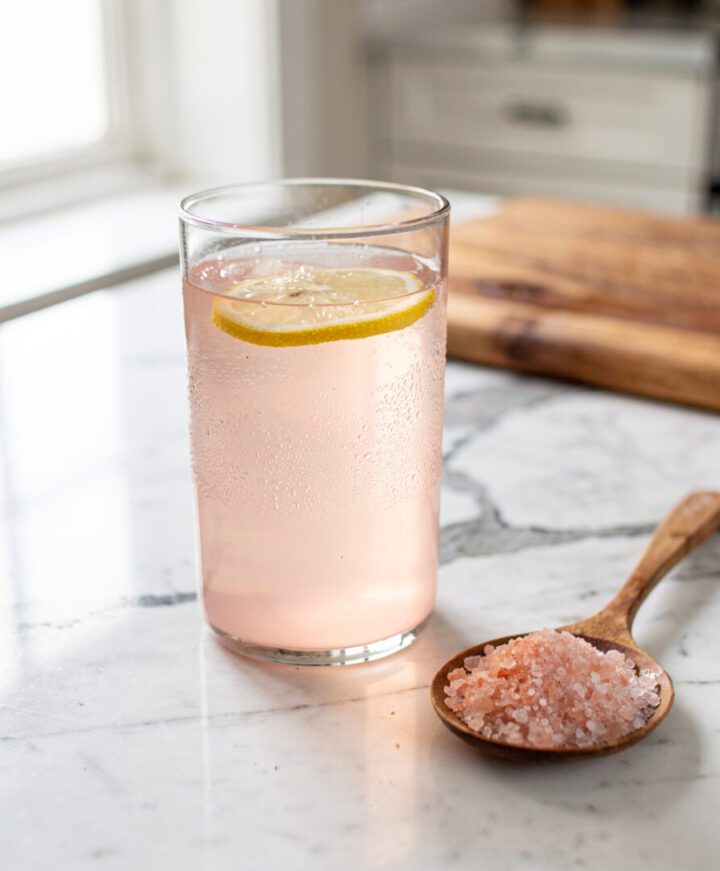
I still remember the morning I nearly blacked out just walking to the kitchen, desperate for a solution that worked.
That was before I understood what a pink himalayan salt electrolyte for POTS could actually do when used with intention, timing, and the right supporting minerals. If you have been told to "eat more salt" and then handed zero follow-up guidance, you are not alone. It is one of the most common complaints in the POTS community. The instruction exists. The protocol does not.
This guide fills that gap. We are covering why POTS patients need sodium at levels most people never approach, what pink Himalayan salt actually contains per serving (real numbers, no marketing fluff), the iodine risk nobody warns you about, who should not sodium-load at all, a practical morning front-loading method, a DIY electrolyte drink recipe, and how to track whether any of it is working. For a foundational recipe to start with, check out this pink himalayan salt electrolyte drink. Let's get into it.
For a full breakdown of pink salt health thresholds and safe daily use limits, the pink himalayan salt cleanse side effects guide covers every risk factor in detail.
Jump to:
- Pink Himalayan Salt Electrolyte for POTS
- Why POTS Patients Need More Sodium Than the Average Person
- What Pink Himalayan Salt Actually Contains (And What It Doesn't)
- The Iodine Problem Nobody Talks About
- Who Should NOT Rely on Sodium Loading for POTS
- How to Use Pink Himalayan Salt Electrolytes for POTS: A Practical Protocol
- DIY Pink Himalayan Salt Electrolyte Drink for POTS
- Pink Himalayan Salt vs. Commercial Electrolyte Products for POTS
- Monitoring Your Response and Knowing When to Adjust
- Conclusion: Your Pink Salt Protocol Starts Tonight
- FAQs about pink himalayan salt electrolyte for POTS

Pink Himalayan Salt Electrolyte for POTS
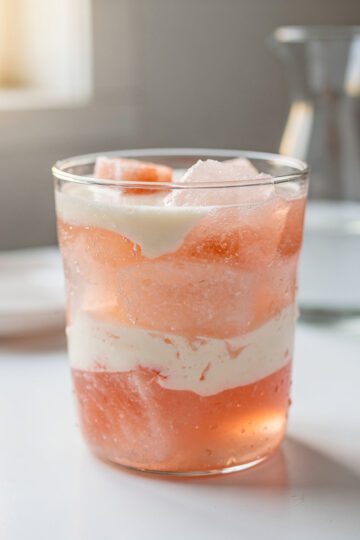
A DIY electrolyte drink designed for POTS patients using pink Himalayan salt, potassium chloride, and magnesium glycinate. This morning front-loading protocol helps expand plasma volume and reduce orthostatic symptoms.
- Total Time5min
- Yield1 serving 1x
- DietDairy Free, Gluten Free
Ingredients
- ¼ teaspoon pink Himalayan salt (approximately 575 mg sodium)
- ⅛ teaspoon No Salt or Nu-Salt potassium chloride substitute (approximately 390 mg potassium)
- 1 small pinch magnesium glycinate powder (50 to 100 mg magnesium)
- Juice of half a lemon
- 500 ml cold filtered water
Instructions
- Fill a glass or bottle with 500 ml cold filtered water.
- Add ¼ teaspoon pink Himalayan salt.
- Add ⅛ teaspoon No Salt or Nu-Salt potassium chloride substitute.
- Add a small pinch of magnesium glycinate powder.
- Squeeze juice of half a lemon into the mixture.
- Stir well until all powders are fully dissolved.
- Drink 20 to 30 minutes before getting out of bed in the morning. Sit upright for 5 minutes before standing.
- For daily use, spread additional sodium intake across 3 to 4 servings throughout the day.
Notes
Consult your doctor before adding potassium chloride if you have kidney disease or take ACE inhibitors, ARBs, or potassium-sparing diuretics. Omit potassium chloride if contraindicated and get potassium from food sources. This recipe is for one serving; adjust amounts for multiple servings. Monitor for ankle swelling or blood pressure changes.
- Prep Time: 5min
- Cook Time: 0min
- Category: Snack
- Method: No-Cook
- Cuisine: American
Nutrition
- Serving Size: 1
- Calories: 5
- Sugar: 0
- Sodium: 575
- Fat: 0
- Saturated Fat: 0
- Unsaturated Fat: 0
- Trans Fat: 0
- Carbohydrates: 1
- Fiber: 0
- Protein: 0
- Cholesterol: 0
Why POTS Patients Need More Sodium Than the Average Person
The Blood Volume Problem at the Root of POTS
Here is the short version of something that feels very complicated when you are living it. POTS is, at its core, a blood volume and circulation problem. Many patients have hypovolemia, meaning reduced plasma volume. When you stand up, blood pools in your legs and lower body because the autonomic nervous system is not signaling the blood vessels to compensate properly.
Your heart panics. It accelerates, sometimes dramatically, trying to push enough oxygenated blood to your brain. Your brain underperforms. You feel dizzy, foggy, nauseated, or all three simultaneously.
Sodium is the primary electrolyte responsible for retaining water in the extracellular space. More sodium means more water retained in the bloodstream, which expands plasma volume, which reduces how hard your heart has to work when you stand. That is the physiological case for sodium loading, and it is well-supported.
What Current Clinical Guidelines Actually Recommend
Dysautonomia International and cardiologist consensus guidelines recommend 3,000 to 10,000 mg of sodium per day for POTS patients. The general population guideline sits at 2,300 mg. That is not a small difference.
This is a clinical recommendation, not a self-prescription. The right target for you depends on your POTS subtype, your blood pressure baseline, your kidney function, and any medications you are taking. The guidance here is meant to inform your conversation with your doctor, not to replace it.
What Pink Himalayan Salt Actually Contains (And What It Doesn't)
The Mineral Profile Per Serving: Real Numbers
Let's address the "84 minerals" claim honestly, because it shows up on every pink salt label and it deserves a factual response. One teaspoon of pink Himalayan salt, roughly 6 grams, contains approximately:
- Sodium: 2,300 mg
- Potassium: 3.5 mg
- Magnesium: 1.06 mg
- Calcium: 1.6 mg
- Iron (as iron oxide, the source of the pink color): 0.037 mg
Those trace minerals are real. They are not fabricated. But they are nutritionally negligible at normal serving sizes. If you need 300 to 400 mg of magnesium daily for vascular support, the 1 mg in your salt is not moving that needle. Pink Himalayan salt is not a meaningful source of potassium or magnesium for POTS management. Understanding this prevents a dangerous assumption: that switching to pink salt covers your mineral bases. It does not.
Pink Salt vs. Table Salt vs. Sea Salt: The Honest Comparison
The sodium content across all three is essentially identical, approximately 2,300 mg per teaspoon. The practical differences are what matter for dysautonomia management.
Table salt contains added iodine and anti-caking agents. Sea salt varies widely by source and processing. Pink Himalayan salt contains no added iodine and no additives.
The legitimate reason to choose a pink himalayan salt electrolyte for POTS is palatability, not mineral superiority. When you are consuming salt at clinical doses daily, a milder-tasting option with no metallic edge supports long-term consistency. That is real. The mineral marketing is not.
The Iodine Problem Nobody Talks About
Why Switching to Pink Salt Creates a Hidden Risk
This is the gap that genuinely concerns me, because it affects a vulnerable population and almost no one discusses it.
Pink Himalayan salt contains approximately 0.1 mcg of iodine per gram. Iodized table salt contains roughly 77 mcg per gram. That is a 770-fold difference. When you swap to pink salt exclusively and consume less seafood or dairy, iodine deficiency becomes a realistic outcome.
POTS disproportionately affects women of reproductive age. Iodine is critical for thyroid hormone production and, during pregnancy, for fetal brain development. Iodine deficiency during early pregnancy is associated with serious, irreversible neurological consequences. This is not a theoretical risk. It deserves a concrete plan.
For the full mineral profile of pink salt and how it supports hydration, the diy pink himalayan salt electrolyte drink guide covers every ingredient ratio in detail.
The Practical Iodine Replacement Checklist
Daily iodine targets are 150 mcg for non-pregnant adults and 220 mcg during pregnancy. Here are the reliable food sources to know:
- Cow's milk: approximately 100 mcg per cup
- Egg: approximately 26 mcg per egg
- Cod (3 oz): approximately 99 mcg
- Nori sheet: approximately 37 mcg (variable by brand and origin)
If your diet does not reliably hit 150 mcg through food, a multivitamin containing 150 mcg of potassium iodide is a simple, low-cost backup. The action step here is specific: audit your iodine intake before eliminating iodized salt entirely. Do not skip this step.
Who Should NOT Rely on Sodium Loading for POTS
Hyperadrenergic POTS: The Critical Exception
Not every POTS patient benefits from aggressive sodium loading. This is one of the most important safety points in this guide, and it is almost entirely absent from competitor content.
Hyperadrenergic POTS is a subtype defined by excessive norepinephrine release on standing. Instead of the blood pressure drop typical of neuropathic POTS, these patients experience a blood pressure rise when they stand up. Their vascular tone is already elevated. Adding more plasma volume on top of already-high vascular resistance can push blood pressure into dangerous territory.
The diagnostic signal to watch for: if standing causes your blood pressure to increase rather than decrease, bring this to your cardiologist or autonomic specialist before increasing sodium. A 24-hour urine catecholamine test can help confirm subtype. The wrong sodium protocol for the wrong POTS subtype is not a minor miscalculation.
Other Contraindications to Discuss With Your Doctor
Several other conditions and medications warrant caution around sodium loading:
- Kidney disease limits your ability to excrete excess sodium safely
- Congestive heart failure raises fluid overload risk significantly
- NSAIDs, ACE inhibitors, and aldosterone antagonists all interact with sodium and fluid balance
- Pregnancy increases sodium requirements but also blood pressure sensitivity, requiring individualized medical guidance rather than a generic protocol
None of these are absolute deal-breakers for every patient. They are reasons to have an informed conversation with your prescribing physician before adjusting your sodium intake at a clinical scale.
How to Use Pink Himalayan Salt Electrolytes for POTS: A Practical Protocol
The Morning Front-Loading Method
Morning is the highest-risk window for most POTS patients, and there are three reasons for that. After hours of lying flat, your cardiovascular system is in recumbency mode. You are relatively dehydrated from overnight fasting. And the cortisol surge that drives you toward waking also spikes your cardiovascular demand. That transition from lying to standing is when symptoms hit hardest.
The fix is a fluid bolus before the transition happens.
Twenty to thirty minutes before getting up, while still in bed or seated with your back supported, drink 500 ml of water mixed with one-quarter teaspoon of pink Himalayan salt, which delivers approximately 575 mg of sodium. Add the juice of half a lemon for palatability. Then sit upright at the edge of the bed for five minutes before standing. This front-loads your plasma volume before your autonomic nervous system has to manage the postural challenge.
This mirrors the pre-standing fluid bolus used in clinical POTS management settings. You can build it into your nightstand routine tonight.
For a pre-workout electrolyte format using the same pink salt ratios, the pink himalayan salt pre-workout drink covers the timing protocol.
Daily Salt Distribution Strategy
Beyond the morning dose, spread your remaining sodium across three to four intake moments throughout the day. Concentrated sodium loads cause GI distress and can cause blood pressure spikes in sensitive patients. Consistent, distributed intake maintains steadier plasma volume.
Practical anchors that work in a real schedule: with breakfast, mid-morning, with lunch, and before planned physical activity.
Ranked by speed of absorption and ease of use, your vehicle options are: DIY electrolyte drink for POTS management first, then salted whole food, then salt capsules, then plain salt water. To simplify your daily routine, consider making a DIY pink himalayan salt electrolyte concentrate that you can dilute as needed.
DIY Pink Himalayan Salt Electrolyte Drink for POTS
The Base Recipe and Why Each Ingredient Is Here
This is a recipe built around function, not flavor trends. Every ingredient has a specific job.
Per 500 ml (approximately 16 oz):
- One-quarter teaspoon pink Himalayan salt (approximately 575 mg sodium)
- One-eighth teaspoon No Salt or Nu-Salt potassium chloride substitute (approximately 390 mg potassium)
- One small pinch magnesium glycinate powder (50 to 100 mg magnesium)
- Juice of half a lemon (palatability, trace potassium)
- 500 ml cold filtered water
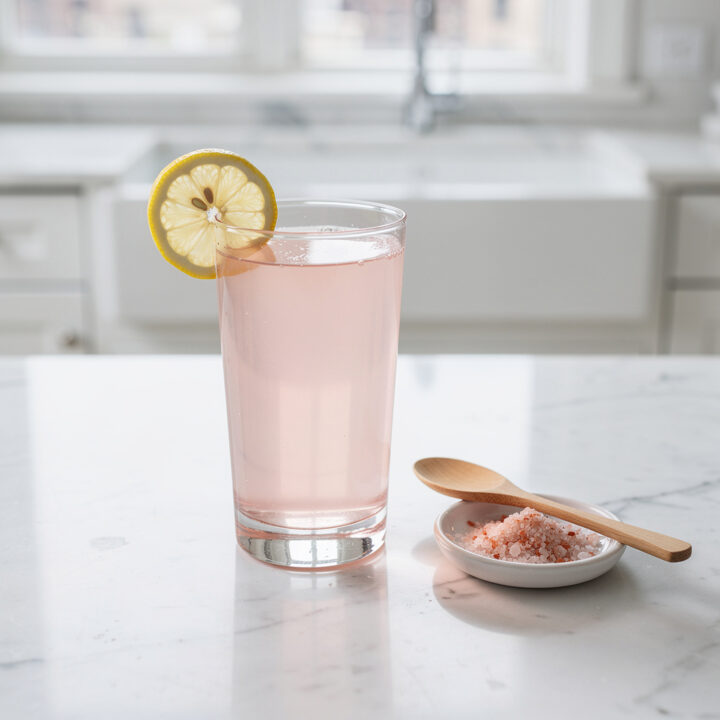
The pink salt handles plasma volume expansion. The potassium chloride supports the sodium-potassium pump and counters any potassium depletion that can result from high sodium intake over time. Magnesium glycinate, specifically the glycinate form for gentler absorption, supports vascular tone and helps reduce the palpitations that are common in POTS. The lemon makes this drinkable twice a day without complaint.
Tiny pink-salt pinches, big function. That is the Salt Clarity approach applied to dysautonomia management.
Safety Note on Potassium Chloride (NoSalt)
Potassium chloride is not safe for everyone. It is contraindicated in kidney disease and interacts with potassium-sparing diuretics, ACE inhibitors, and ARBs. These are common prescriptions in the POTS population.
Confirm with your prescribing physician before adding potassium chloride to your daily routine. If it is contraindicated for you, omit it entirely. Do not substitute a higher dose of anything else. Instead, focus on dietary potassium sources: bananas, avocado, sweet potato, and cooked white beans are all practical, affordable options that require no supplementation calculations.
Pink Himalayan Salt vs. Commercial Electrolyte Products for POTS
When to Choose DIY Over Packaged Products
Cost is real and it matters. A DIY pink himalayan salt electrolyte for POTS costs approximately five to ten cents per serving. Premium POTS-targeted electrolyte products like LMNT, Normalyte, and Vitassium range from one dollar and fifty cents to two dollars and fifty cents per serving. Over a month of daily use, that gap adds up fast.
Beyond cost, DIY gives you precise control over the sodium, potassium, and magnesium ratios. Symptoms change. Your protocol should adapt. A packaged product cannot do that without you buying a different SKU.
The limitation is real too: DIY requires accurate measuring, daily consistency, and confirmed safety of each component. It is not for everyone.
When Packaged Products Serve POTS Patients Better
Travel, work environments, and acute flares are the three moments where packaged products win on convenience.
For packaged products to be clinically relevant for POTS management, sodium per serving must be at least 1,000 mg. Here is a quick comparison:
| Product | Sodium Per Serving |
|---|---|
| Normalyte | approximately 1,780 mg |
| LMNT | approximately 1,000 mg |
| Vitassium Capsules | approximately 500 mg, stackable |
| Gatorade | approximately 270 mg |
Gatorade is a sports drink. It is not a POTS management tool. Read the sodium number, not the "electrolyte blend" marketing language on the front of the package.
One more note: a meaningful subset of POTS patients, particularly those with comorbid mast cell activation syndrome (MCAS), report sensitivity to artificial sweeteners and stevia. Unflavored options like LMNT Raw or Keto Chow Electrolyte Drops address that.
For a no-cost DIY electrolyte concentrate you can batch prep weekly, the diy pink himalayan salt electrolyte concentrate covers the full method.
Monitoring Your Response and Knowing When to Adjust
How to Track Whether Salt Loading Is Working
Two weeks of consistent, simple logging gives you actionable signal. Record: date, total sodium intake estimate, total fluid intake, worst symptom of the day, and your standing heart rate delta (the difference between your heart rate seated and your heart rate after standing for two minutes).
The clinical target for that delta is under 30 beats per minute. Most POTS patients see it above 30 on bad days, sometimes far above. Watch how it shifts as your sodium protocol stabilizes.
Also monitor for ankle swelling. Some puffiness after a higher sodium day is normal. Persistent, progressive swelling around the ankles or lower legs is a sign of over-retention and needs medical review.
Red Flags That Mean Stopping and Seeking Review
Stop your sodium loading protocol and contact your doctor if you experience any of the following:
- Persistent ankle or lower leg swelling that does not resolve overnight
- Headaches that worsen on standing rather than improving (this could indicate rising blood pressure rather than orthostatic hypotension)
- New or worsening shortness of breath
- Noticeable increase in blood pressure readings if you monitor at home
These are not reasons to panic. They are feedback. Your body is telling you the dose, the timing, or the approach needs adjustment.
Conclusion: Your Pink Salt Protocol Starts Tonight
The science behind using a pink himalayan salt electrolyte for POTS is solid. The morning front-loading method is practical. The DIY drink recipe is affordable, functional, and built on real mineral logic. And the warnings in this guide, around hyperadrenergic POTS, iodine displacement, and medication interactions, are the ones that protect you from well-intentioned mistakes.
Start with the nightstand glass. One-quarter teaspoon of pink Himalayan salt in 500 ml of water, thirty minutes before you stand. Track two weeks. Notice what shifts. For a warmer weather variation, explore this pink himalayan salt electrolyte drink for hot weather.
Try smarter, not stricter. That applies to dysautonomia management just as much as it applies to cooking.
For those exploring natural approaches to metabolic and weight management alongside POTS care, the guide to natural alternatives to Mounjaro covers complementary strategies.
Let me know how it turns out in the comments. I read every one, and I would genuinely love to hear how your mornings change.
FAQs about pink himalayan salt electrolyte for POTS
Yes, pink Himalayan salt is widely recommended for POTS (Postural Orthostatic Tachycardia Syndrome) because its high sodium content helps increase blood volume and stabilize blood pressure. The trace minerals it contains, including potassium and magnesium, also support overall electrolyte balance. Always consult your doctor before significantly increasing salt intake, as individual needs vary.
Most POTS specialists recommend consuming between 3,000 and 10,000 mg of sodium per day, though the exact amount depends on your specific condition and doctor's guidance. Using pink Himalayan salt as your primary electrolyte source can help meet this target through food seasoning, salt supplements, or electrolyte drinks. Always work with your healthcare provider to determine the right daily sodium intake for your severity of POTS.
The best electrolyte drinks for POTS are those high in sodium, such as homemade pink Himalayan salt electrolyte water made with water, pink Himalayan salt, a small amount of potassium, and lemon juice. Commercial options like LMNT or Liquid IV are also popular among POTS patients because of their high sodium content. Avoid low-sodium sports drinks like standard Gatorade, as they may not provide sufficient electrolytes for POTS management.
Yes, increasing sodium intake through pink Himalayan salt electrolytes can help reduce dizziness and fainting episodes in POTS by expanding plasma blood volume and improving circulation to the brain. When blood volume is low, the heart compensates by beating faster, triggering POTS symptoms, and adequate sodium intake helps counteract this response. Pairing pink Himalayan salt with adequate fluid intake maximizes its effectiveness in reducing these episodes.
To make a simple pink Himalayan salt electrolyte drink for POTS, mix 16 oz of water with ¼ teaspoon of pink Himalayan salt, a squeeze of fresh lemon juice, and a small amount of honey or a potassium source like cream of tartar. This combination provides sodium, potassium, and natural sugars to help stabilize blood pressure and energy levels. Drink it slowly throughout the day rather than all at once for the best results.
Pink Himalayan salt is often preferred over regular table salt for POTS because it contains over 80 trace minerals, including potassium, magnesium, and calcium, which support broader electrolyte balance. Regular table salt provides only sodium chloride and is often heavily processed, while pink Himalayan salt is minimally refined and free of additives. However, both can effectively raise sodium levels for POTS management, making pink Himalayan salt the preferred choice for those seeking additional mineral benefits.
💬 Lets Stay Connected!
For daily recipes, kitchen tips, and exclusive content, follow me on:
👉 Facebook for behind the scenes & community fun
👉 Pinterest for visual inspiration & meal ideas
👉 X (Twitter) for quick tips & trending recipes
📲 Join the flavor journey, your next favorite recipe is just a follow away!
Disclaimer: This content is provided for general informational and educational purposes only. It is not intended as medical, nutritional, or professional advice. Always consult a qualified healthcare professional or registered dietitian before making changes to your diet, health routine, or lifestyle. Individual needs and results may vary

Leave a Reply